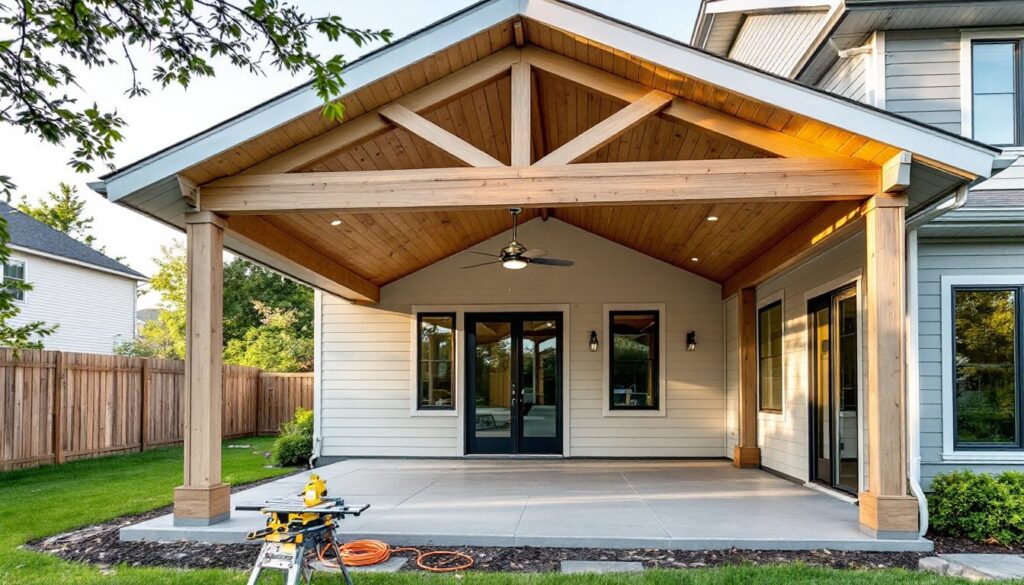

A covered patio transforms a bare concrete slab into a year-round living space, but the cost of covered patio construction varies wildly depending on materials, size, and structural complexity. Homeowners in 2026 can expect to spend anywhere from $3,000 for a basic pergola kit to over $35,000 for a custom gable roof extension with electrical and ceiling fans. Understanding how much does a covered patio cost requires breaking down the components: framing, roofing materials, footings, labor, and whether the structure attaches to the house or stands alone. This guide walks through real-world pricing, material trade-offs, and where DIY efforts can actually cut costs without compromising structural integrity.
Table of Contents
ToggleKey Takeaways
- The national average covered patio cost in 2026 ranges from $8,000 to $28,000, with most homeowners spending around $17,800 for a mid-range 200–300 square foot structure.
- Attached roof extensions cost $12–$28 per square foot depending on materials, while free-standing pergolas and pavilions offer cost savings by eliminating ledger board complexity and permit requirements.
- Labor, material grade, roof type, electrical work, and local code requirements are the primary cost drivers—with regional labor rates varying from $35–$50 per hour in the Midwest to $75–$100 per hour on the coasts.
- DIY installation can reduce covered patio expenses by 40–60%, but professionals are essential for attached structures, permitted projects, electrical work, and complex roof designs to avoid costly mistakes.
- Strategic cost reductions include starting with a smaller 12×16-foot footprint, using pressure-treated lumber instead of cedar, choosing metal roofing, and deferring electrical work to a later phase.
- A well-built covered patio adds $5,000–$15,000 to home resale value and extends usable outdoor living space year-round, making structural integrity investments worthwhile despite upfront expenses.
Average Cost to Build a Covered Patio
In 2026, the national average for a covered patio project sits between $8,000 and $28,000, with most homeowners paying around $17,800 for a mid-range build. That baseline typically covers a 200–300 square foot attached structure with composite decking, pressure-treated lumber framing, and asphalt shingle roofing.
Regional labor rates create the widest swings. A contractor in the Midwest might charge $35–$50 per hour for framing labor, while coastal markets like Southern California or the Northeast push that to $75–$100 per hour. Material costs have stabilized since 2024’s lumber volatility, but engineered lumber (LVL beams, glulam posts) still runs 20–30% higher than dimensional lumber.
Size matters, obviously. A 12×12-foot pergola costs far less than a 20×30-foot pavilion. But the real cost driver is structural complexity. A simple lean-to roof with rafters on 16-inch centers is straightforward. A hip roof with cathedral ceilings, recessed lighting, and electrical circuits requires engineered plans, a permit, and probably a licensed contractor. Expect to add $2,500–$5,000 for electrical rough-in and another $1,200–$2,000 for permits and plan reviews in most jurisdictions.
Foundation work also sneaks into budgets. Frost-line footings for free-standing posts can run $150–$300 per hole if you hire an excavator. DIYers with a post-hole digger and a weekend can handle this, but code requires footings below frost depth, 48 inches in Minnesota, 12 inches in Texas. Check your local IRC amendments before mixing concrete.
Cost Breakdown by Patio Cover Type
Roof Extensions and Attached Covers
Attached patio covers tie into the existing roofline and fascia, creating a seamless extension. This design offers the best weather protection but requires flashing, ledger board attachment to the house’s rim joist, and often an engineer’s stamp if the span exceeds 16 feet.
Material and cost options:
- Asphalt shingle roof over dimensional lumber: $12–$18 per square foot installed. Uses 2×6 or 2×8 rafters, 4×4 or 6×6 posts, and matches most residential roofing. Budget $3,600–$5,400 for a 12×25-foot cover.
- Standing seam metal roof: $18–$28 per square foot. Lasts 40+ years, sheds snow and leaves efficiently, and works well in wildfire-prone areas. Aluminum panels run cheaper than Galvalume or copper.
- Polycarbonate or fiberglass panels: $8–$14 per square foot. Lets diffused light through, which keeps the space bright but can create a greenhouse effect in summer. Common in sunroom conversions.
Labor for attached covers typically accounts for 50–60% of the total. A professional crew can frame and roof a basic 15×20-foot structure in 3–4 days, billing $5,000–$8,000 in labor alone.
Permit requirements are stricter for attached structures because they alter the building envelope. Flashing must integrate with house wrap and siding, and ledger bolts must hit solid framing, not just sheathing. Many jurisdictions now require patio enclosure work to include a sealed drawing if the roof load exceeds 40 PSF live load (snow country) or if it ties into a second-story deck.
Pergolas and Pavilions
Pergolas use open rafters or lattice for partial shade. Pavilions feature a solid roof but stand independent of the house. Both avoid the ledger board complexity of attached covers, which can lower costs, or raise them if you need four corner footings instead of two.
Pergola costs:
- Prefab vinyl or aluminum kits: $1,500–$4,000 for a 10×12-foot unit. Assembly takes a weekend with basic tools. Not structural, wind ratings rarely exceed 90 mph, so these suit sheltered yards.
- Custom wood pergola: $8–$15 per square foot. Cedar or redwood resists rot better than pine but costs 40–60% more. A 16×20-foot cedar pergola with 6×6 posts and 2×8 cross beams runs $2,500–$4,800 in materials, plus $2,000–$3,500 for professional installation.
- Retractable canopy pergolas: $12–$22 per square foot. Motorized fabric panels add convenience but require 120V electrical and annual fabric maintenance.
Pavilion costs:
- Gable or hip roof pavilion: $18–$35 per square foot. Requires traditional roof framing (ridge beam, rafters, sheathing, shingles) and four corner posts on footings. A 12×16-foot pavilion typically costs $3,500–$6,700 in materials and $4,000–$7,500 in labor.
- Timber frame pavilions: $35–$60 per square foot. Exposed mortise-and-tenon joinery and oversized beams create a premium look but demand specialized carpentry. These are showpieces, not budget builds.
Free-standing structures simplify permitting in some areas, many codes allow up to 200 square feet without a permit if setbacks are met. But if you add plumbing, electrical, or a fireplace, you’re back in permit territory.
Factors That Affect Your Covered Patio Cost
Material grade: Pressure-treated southern yellow pine is the budget standard at $4–$6 per board foot, but it warps more than Douglas fir or hem-fir. Cedar and redwood start at $8–$12 per board foot and require less maintenance. Composite or PVC trim boards for fascia and post wraps add $3–$5 per linear foot but eliminate rot and painting.
Roofing substrate: OSB sheathing costs $12–$18 per 4×8 sheet: plywood runs $25–$35. In high-moisture climates, plywood’s edge-swell resistance justifies the premium. Synthetic underlayment (versus felt paper) adds $50–$100 to a typical patio roof but improves waterproofing.
Post and beam sizing: Span tables dictate minimum sizes. A 12-foot beam span might require a 4×8 or double 2×8, while a 20-foot span needs a 6×10 LVL beam at $15–$22 per linear foot. Undersizing beams to save $200 in materials leads to sag and potential structural failure.
Site access and grading: If trucks can’t reach the backyard, material delivery costs spike. Hand-carrying 16-foot LVL beams through a side gate adds labor hours. Sloped lots require stepped footings or retaining walls, adding $1,500–$4,000 to foundation costs.
Electrical and lighting: A single 15-amp circuit for string lights and a ceiling fan costs $800–$1,500 installed, including a weatherproof panel subpanel if the main panel is distant. Recessed can lights in a wood-framed ceiling require IC-rated housings and add $120–$180 per fixture.
Finish details: Staining or painting adds $2–$4 per square foot of surface area. A 300-square-foot patio cover has roughly 600 square feet of exposed wood (posts, beams, underside of roof decking). That’s $1,200–$2,400 for two coats of solid stain or exterior paint. Homeowners who skip this see untreated pine go gray or start checking within two seasons.
Local code amendments: Hurricane zones require Simpson Strong-Tie brackets and additional anchor bolts. Wildfire hazard zones mandate ignition-resistant materials (metal roofing, cement board siding). Seismic regions need hold-down anchors at posts. These add $300–$800 in hardware but aren’t optional.
DIY vs. Professional Installation: Which Saves More?
DIY can cut costs by 40–60%, but only if the homeowner has framing experience and the right tools. A basic pergola kit is achievable for a competent DIYer, most require a circular saw, drill, level, post-hole digger, and a second pair of hands. Budget 16–24 hours for a 10×12-foot kit, including setting posts in concrete and squaring the frame.
Custom framing is a different story. Cutting rafters with a speed square and marking bird’s mouth notches is straightforward, but getting the roof pitch consistent across eight rafters takes practice. A miter saw or circular saw with a guide works, though a compound miter saw gives cleaner cuts on angled ends. Homeowners comfortable with layout and basic carpentry can tackle a simple gable roof, but hip roofs or cathedral ceilings with collar ties require more skill.
Where DIY makes sense:
- Prefab pergola or pavilion kits under 200 square feet
- Simple lean-to roof with uniform rafter spacing
- Footings in sandy or loose soil (easy digging)
- Cosmetic work: staining, lattice panels, trim carpentry
Where professionals are worth it:
- Attached covers requiring ledger board flashing and structural ties to the house
- Any project needing a permit and engineered drawings (many jurisdictions won’t issue permits for DIY structural work)
- Electrical rough-in (unless the homeowner is a licensed electrician)
- Roof pitches over 6:12 or spans over 16 feet
- Concrete footings in clay or rocky soil
Tool costs eat into DIY savings. A decent compound miter saw runs $250–$400, a framing nailer $150–$300 (plus compressor), and a laser level $80–$150. Renting is cheaper for one-off projects, $40–$60 per day for a framing nailer, $25–$40 for a post-hole auger.
Mistakes cost more than labor. An incorrectly flashed ledger board can funnel water into wall cavities, leading to $5,000+ in rot repair. Posts set above frost line heave in winter, cracking concrete and racking the frame. For homeowners researching contractors, platforms like Angi and ImproveNet provide reviews and project cost benchmarks.
Ways to Reduce Your Covered Patio Expenses
Start with a smaller footprint. A 12×16-foot structure delivers 192 square feet of usable space at a fraction of the cost of a 20×20-foot build. You can always add side screens or a second phase later.
Choose pressure-treated lumber over premium species. Southern yellow pine treated to ground-contact standards (.40 retention) costs half as much as cedar and lasts 20+ years if sealed annually. Save the cedar for visible trim and post wraps.
Use metal roofing instead of shingles. Standing seam panels cost more upfront but eliminate the need for sheathing and underlayment. Corrugated metal over purlins is even cheaper, $6–$10 per square foot installed, and works well for rustic or modern aesthetics.
Skip the electrical in phase one. Solar string lights and battery-powered fans let homeowners use the space immediately. Adding a dedicated circuit later costs the same whether you do it now or in two years.
Buy materials in the off-season. Lumber prices dip in late fall and winter when construction slows. Roofing suppliers discount asphalt shingles after September to clear inventory.
Handle the prep and demo yourself. Contractors charge $50–$75 per hour for site clearing, but homeowners can remove old decking, pull weeds, and level the ground with a weekend and a rented plate compactor ($60–$80 per day).
Reuse existing footings or posts. If an old deck or patio cover is structurally sound but cosmetically tired, new rafters and roofing over existing posts can save $2,000–$4,000 in foundation and framing costs.
Get multiple bids. Contractor estimates for the same project often vary by 30–50%. Three written bids highlight where you’re paying for skill versus markup.
Pull your own permit. Some jurisdictions allow homeowners to permit their own work, saving the contractor’s admin fee ($300–$600). You’ll attend the inspections and coordinate scheduling, but it’s straightforward for simple structures.
No shortcuts on structural integrity, though. Undersized beams, shallow footings, or missing flashing will cost far more to fix than the initial savings. A well-built covered patio adds $5,000–$15,000 to home resale value and extends outdoor living six months a year in most climates.