
Vinyl plank flooring, often called LVP (luxury vinyl plank) or LVT (luxury vinyl tile), has become one of the most popular flooring choices for homeowners who want the look of hardwood without the price tag or maintenance headaches. It’s durable, water-resistant, and comes in styles that can fool most guests into thinking they’re walking on real oak or maple. But before ripping out that old carpet, most DIYers and homeowners want to know one thing: what’s this project actually going to cost? The answer depends on whether you’re swinging the tools yourself or calling in a pro, the type of vinyl you choose, and what’s hiding underneath your current floor.
Table of Contents
ToggleKey Takeaways
- Vinyl plank flooring installation cost typically ranges from $3–$10 per square foot when hiring a professional installer, with a 200-square-foot room averaging $600–$2,000 total.
- Material costs for vinyl plank flooring vary from $1–$5 per square foot depending on quality and type, while professional labor averages $2–$5 per square foot.
- DIY vinyl plank flooring installation can save 50–70% compared to professional installation, costing roughly $300–$1,200 for a 200-square-foot room, making it an accessible option for homeowners with basic tools.
- Subfloor condition is critical for vinyl plank flooring installation cost; poor subfloors require self-leveling compound ($2–$4/sq ft) or underlayment, adding significantly to the total budget.
- Removing old flooring (especially ceramic tile at $3–$5/sq ft) and choosing simple plank patterns over diagonal or herringbone layouts can save substantial labor costs.
- Purchasing vinyl plank flooring during off-peak seasons (January–February or August–September) can reduce costs by 15–30%, and getting at least three local quotes helps establish realistic regional pricing.
Average Cost to Install Vinyl Plank Flooring
As of 2026, vinyl plank flooring installation cost per square foot typically runs between $3 and $10 when hiring a professional installer. That range accounts for both materials and labor. For a standard 200-square-foot room, homeowners can expect to pay roughly $600 to $2,000 all-in.
Breaking it down further:
- Material costs: Vinyl plank flooring itself ranges from $1 to $5 per square foot, depending on quality, thickness (common options are 4mm, 6mm, or 8mm), and wear layer durability. Basic builder-grade LVP starts around $1/sq ft, while premium waterproof options with attached underlayment and realistic embossing can hit $5/sq ft or more.
- Labor costs: Professional installation averages $2 to $5 per square foot. This includes surface prep, underlayment (if needed), cutting, fitting, and cleanup. Complex layouts, pattern work, or removing old flooring bumps up the labor rate.
Nationwide averages show most homeowners spend around $2,500 to $3,000 for a full main-floor installation (around 500–600 sq ft), but regional differences matter. Urban markets like San Francisco or New York can run 20–30% higher than rural areas in the Midwest or South. Always get at least three local quotes to establish a realistic baseline for your zip code.
Cost Breakdown by Installation Type
Professional Installation Costs
Hiring a pro means paying for expertise, speed, and, most importantly, warranty protection. Many manufacturers require professional installation to honor their product warranties, especially on high-end LVP or LVT products.
What’s included in professional installation:
- Surface prep: Leveling subfloors (critical for click-lock planks), patching concrete, or installing a moisture barrier. Uneven subfloors cause planks to buckle or gaps to form.
- Underlayment: Not all vinyl needs it, but pros often install a 2mm foam underlayment for sound dampening and minor subfloor imperfection forgiveness. Cost: about $0.50–$1.00/sq ft.
- Cutting and fitting: Proper expansion gaps (typically 1/4 inch around perimeters), scribing around door jambs and trim, and pattern matching on wood-look planks.
- Removal and disposal: Tearing out old flooring (carpet, tile, or laminate) adds $1–$3/sq ft to the bill. Carpet is easiest: ceramic tile removal is the priciest due to labor intensity.
LVP flooring installation cost through a contractor averages $4–$8/sq ft installed, depending on job complexity. For instance, typical vinyl flooring installation projects in 2025 averaged around $2,561 for moderate-sized rooms, though this can vary based on region and materials selected.
DIY Installation Costs
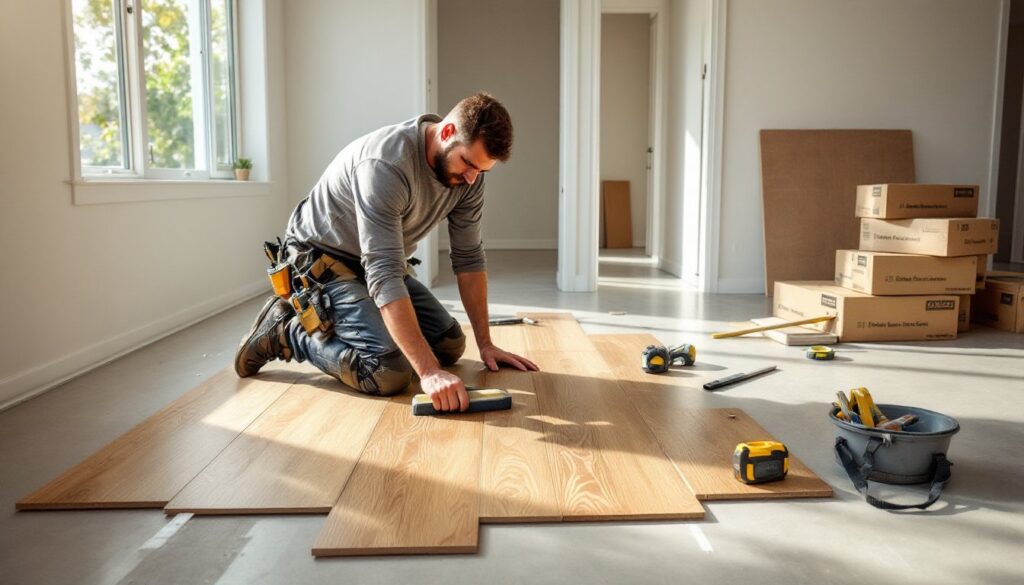
Click-lock vinyl plank is one of the most DIY-friendly flooring options available. No nails, no glue (in most cases), and no need for a table saw if you’ve got a decent utility knife and a straight edge.
DIY cost breakdown:
- Materials only: $1–$5/sq ft for the planks themselves.
- Underlayment (if not attached): $0.50–$1.00/sq ft.
- Tools and supplies: Most DIYers already own a tape measure, utility knife, and straight edge. You may need to rent or buy:
- Vinyl cutter or laminate shears ($20–$40)
- Tapping block and pull bar ($15–$25)
- Spacers for expansion gaps ($5–$10)
- Transition strips and trim ($3–$8 per strip)
Total DIY cost for a 200 sq ft room: Roughly $300–$1,200, depending on plank quality. That’s a potential savings of 50–70% compared to hiring out.
Effort required: Plan on 6–10 hours for a beginner tackling a simple rectangular room. Bathrooms with toilets and vanities, or kitchens with islands, add complexity. You’ll spend more time scribing and cutting than actually laying planks.
Watch out for: Subfloor prep. If your concrete slab has a moisture issue or your wood subfloor has dips greater than 1/8 inch over 6 feet, you’ll need to address it first. Skipping this step is the #1 cause of DIY vinyl floor failures.
Factors That Affect Installation Costs
Several variables can push your vinyl flooring installation cost up or down. Here’s what moves the needle:
1. Plank type and quality
- Rigid core (SPC or WPC): Stone plastic composite (SPC) and wood plastic composite (WPC) planks are thicker, more stable, and pricier, often $3–$5/sq ft. They handle temperature swings and subfloor imperfections better than standard LVP.
- Glue-down vs. click-lock: Glue-down vinyl is cheaper per square foot ($1–$3) but labor-intensive and not DIY-friendly. Click-lock flooring costs more upfront but installs faster and easier.
2. Subfloor condition
If your subfloor needs work, budget accordingly:
- Self-leveling compound: About $2–$4/sq ft if a concrete slab is wavy or sloped.
- Plywood underlayment over old wood floors: Adds $1–$2/sq ft in materials and labor.
- Moisture barrier: Required over concrete slabs in basements or on-grade installations. Expect $0.50–$1/sq ft.
3. Room size and layout
Larger rooms reduce the per-square-foot cost due to economies of scale. Smaller rooms, hallways, and closets cost more per square foot because of setup time and waste from cuts. Diagonal or herringbone patterns look sharp but increase material waste by 10–15% and labor time significantly.
4. Old flooring removal
You can sometimes install LVP over existing flooring if it’s smooth, level, and firmly attached:
- Over old vinyl or linoleum: Usually fine if it’s not cushioned or embossed.
- Over ceramic tile: Possible if grout lines are filled and the surface is level.
- Over carpet: Never. Carpet and padding must come out.
Removal costs vary by material. Carpet removal runs about $1–$1.50/sq ft, while tile can hit $3–$5/sq ft if it’s stubborn or requires subfloor repair afterward.
5. Geographic location
Labor rates vary widely. A flooring installer in rural Iowa might charge $2/sq ft, while the same job in Boston could be $5/sq ft or more. As noted in many home renovation guides, regional cost differences and local market conditions play a huge role in final pricing.
6. Transitions and trim
Don’t forget the finishing touches:
- Transition strips (T-molding, reducers, thresholds): $3–$8 each.
- Quarter-round or baseboard: If you’re replacing trim, add $1–$3/linear foot for materials and installation.
How to Save Money on Vinyl Plank Flooring Installation
Vinyl plank flooring is already budget-friendly compared to hardwood or tile, but there are smart ways to trim the LVT flooring installation cost even further without sacrificing quality.
1. Do the demo yourself
Removing old carpet or peel-and-stick tile is grunt work, not skilled labor. Rent a dumpster, grab a pry bar and utility knife, and handle the tearout over a weekend. You’ll save $1–$3/sq ft in labor.
2. Buy during off-peak seasons
Flooring retailers often run sales in late winter (January–February) and late summer (August–September) when demand is lower. You can snag premium LVP for 15–30% off retail.
3. Skip the underlayment if it’s attached
Many modern vinyl planks come with a pre-attached foam or cork underlayment. Don’t double up unless you’re soundproofing a second-floor installation. Check the manufacturer specs.
4. Buy extra material upfront
Planks from different production runs can vary slightly in color. Purchase 10% extra to cover waste and future repairs. Leftover boxes from discontinued lines can sometimes be found at steep discounts, but you risk not being able to match later.
5. Simplify the layout
Stick to a straight plank pattern running parallel to the longest wall. Diagonal, herringbone, or mixed-width patterns are eye-catching but add labor hours and material waste. For projects covered in resources like engineered vinyl plank guides, simpler installations consistently save money without compromising durability.
6. Get multiple quotes
Pricing can vary by 20–40% between contractors for the same job. Get at least three written estimates with line-item breakdowns (material, labor, prep, removal). Don’t automatically pick the cheapest, verify they’re licensed, insured, and have solid references.
7. Consider mid-grade planks
The jump from builder-grade to mid-tier vinyl (around $2–$3/sq ft) gets you better wear layers (12–20 mil), more realistic textures, and longer warranties. The jump from mid-tier to premium often buys marginal improvements that most homeowners won’t notice in everyday use.
Conclusion
Vinyl plank flooring delivers the look of hardwood at a fraction of the cost, and installation, whether DIY or professional, won’t expensive if you plan carefully. Budget $3–$10/sq ft installed for most projects, factor in subfloor prep and removal costs, and don’t skimp on the details that make the difference between a floor that lasts five years and one that lasts twenty. Get your quotes, do your assignments, and you’ll have a floor you’re proud to walk on.