
Replacing old carpet or installing new flooring isn’t just about picking a color that matches the drapes. It’s about understanding what you’ll actually pay when the installer rolls out their tape measure. Carpet installation costs vary wildly, from $3 to $20+ per square foot, depending on material, padding, room prep, and labor. That means a standard 12×15 living room could run anywhere from $540 to over $3,600. This guide breaks down the real numbers for 2026, so homeowners can budget accurately, compare options, and decide whether to hire a pro or tackle the job themselves.
Table of Contents
ToggleKey Takeaways
- Carpet installation costs range from $3 to $20+ per square foot, with a 12×15 living room typically ranging from $540 to $3,600 depending on material, padding, and labor.
- Material quality is the biggest cost driver, ranging from under $1 per square foot for builder-grade polyester to $15+ for hand-tufted wool, making fiber choice critical to your budget.
- Professional carpet installation labor averages $0.50 to $3.00 per square foot nationally, with complex layouts, stairs, and subfloor prep adding significant costs that homeowners should account for upfront.
- DIY carpet installation can save $0.50 to $3 per square foot in labor ($200–$600 in savings for typical projects), but requires proper tools, skill, and time—mistakes can ultimately cost more than professional installation.
- Subfloor condition, removal of old flooring, seaming, transition strips, and baseboard work are hidden costs that frequently exceed initial expectations and should be confirmed with contractors before signing a contract.
- Nylon and Triexta carpet offer the best value for busy households, balancing durability and stain resistance at $4.50 to $10 per square foot installed, while wool represents a premium option for long-term durability at $7 to $19 per square foot.
What Determines Carpet Installation Costs?
Carpet installation cost isn’t a single number, it’s a stack of variables that add up fast. Understanding these factors helps homeowners get accurate quotes and avoid sticker shock at checkout.
Material quality is the biggest driver. Carpet prices range from under $1 per square foot for builder-grade polyester to $15+ per square foot for hand-tufted wool. Fiber type, density, and pile height all affect durability and price.
Padding sits underneath and matters more than most people think. Quality underlayment extends carpet life, improves comfort, and boosts insulation. Expect to pay $0.50 to $1.50 per square foot for decent padding. Skimping here shortens carpet lifespan and voids some warranties.
Room size and layout impact labor costs. Installers charge more per square foot for small, oddly shaped rooms than for wide-open spaces. Stairs, closets, and hallways require precision cuts and seaming, billable time adds up.
Subfloor condition can derail a budget. If the existing subfloor is uneven, damaged, or water-stained, it needs repair before carpet goes down. Patching plywood or leveling concrete adds $1 to $3 per square foot.
Removal and disposal of old flooring isn’t always included in quotes. Pulling up and hauling away old carpet, tack strips, and padding typically costs $1 to $2 per square foot. Some installers bundle this: others charge separately.
Geographic location shifts prices significantly. Urban markets and high-cost-of-living regions see higher labor rates. A job in San Francisco or New York will cost more than the same work in rural Tennessee.
Finally, installation method matters. Stretch-in (the standard approach using tack strips) is cheaper than glue-down installation, which requires adhesive and longer labor hours.
Average Carpet Installation Costs by Material Type
The cost for carpet installation hinges on fiber choice. Here’s what to expect across the spectrum in 2026.
Budget-Friendly Options: Polyester and Olefin
Polyester and olefin (polypropylene) carpet deliver the lowest upfront costs. Polyester runs $1 to $4 per square foot for material, plus $0.50 to $2 for installation labor. It’s soft underfoot, resists stains decently, and works well in low-traffic bedrooms. But it crushes under heavy furniture and wears faster in hallways or living rooms.
Olefin sits in a similar price range, $1 to $3.50 per square foot, and excels in moisture resistance, making it a go-to for basements. It’s less resilient than nylon and can mat down, but for budget-conscious homeowners, it’s a solid temporary or rental-property solution. Combined material and installation cost for a 200-square-foot bedroom typically lands between $400 and $900.
Mid-Range Choices: Nylon and Triexta
Nylon dominates the residential carpet market for good reason. It’s tough, resilient, and holds up to foot traffic better than polyester. Material costs range from $2.50 to $8 per square foot, with labor adding another $1 to $3. Total carpet installation prices for a 300-square-foot living room average $1,050 to $3,300.
Nylon carpets come in multiple generations, nylon 6 and nylon 6,6, with the latter offering slightly better stain resistance and durability. Both rebound well after compression, making them ideal for busy households.
Triexta (often branded as SmartStrand) is a newer synthetic that rivals nylon in durability while offering superior stain and moisture resistance. It costs $3 to $7 per square foot for materials. Installation of carpet cost stays similar to nylon, so expect total costs between $4.50 and $10 per square foot installed. It’s a smart pick for homes with kids or pets.
Premium Selections: Wool and Specialty Carpets
Wool is the luxury tier. Natural, renewable, and long-lasting, wool carpet runs $5 to $15 per square foot for materials alone. Add $2 to $4 per square foot for professional installation, and a 250-square-foot master bedroom could cost $1,750 to $4,750. Wool resists soil naturally, feels incredible underfoot, and lasts decades with proper care. But it’s vulnerable to moisture and requires professional cleaning.
Specialty carpets, including custom patterns, Berber styles, and performance blends, vary widely. Berber (looped construction) ranges from $3 to $12 per square foot depending on fiber. High-performance carpets engineered for commercial-grade durability can hit $10 to $20 per square foot installed. These make sense in high-traffic entryways or for homeowners planning to stay put for 15+ years.
For a realistic comparison, many professional cost guides estimate the average cost for carpet installation nationally between $780 and $2,813 for typical whole-room projects.
Labor Costs and Additional Installation Fees
Labor is where carpet installation cost per square foot can surprise homeowners. The national average for professional installation runs $0.50 to $3.00 per square foot, but that’s before add-ons.
Most installers charge a base labor rate that covers measuring, cutting, stretching, and securing carpet with tack strips. Expect $0.75 to $1.50 per square foot for straightforward rooms with few obstructions. Complex layouts, rooms with bay windows, built-in shelving, or multiple doorways, push rates toward $2 to $3 per square foot.
Stair installation is labor-intensive and billed separately, typically $3 to $10 per step. A standard 13-step staircase adds $40 to $130 to the total bill. Installers must wrap treads, risers, and sometimes spindles, requiring precision and patience.
Furniture removal isn’t always included. Some pros offer it for $50 to $150 flat, others charge $25 to $50 per room. If the homeowner can clear the space beforehand, that’s money saved.
Seaming fees apply when carpet width doesn’t cover a room in one piece. Installers heat-seal seams using specialized tape and irons. Seaming is included in most labor quotes, but ask upfront, some contractors charge $1 to $2 per linear foot for excess seaming.
Transition strips bridge carpet to tile, hardwood, or vinyl. Metal or wood transitions cost $3 to $8 per linear foot installed. These aren’t optional, they prevent tripping hazards and protect carpet edges.
Moving or reinstalling baseboards can add $1 to $2.50 per linear foot. Some installers tuck carpet under existing baseboards: others prefer to remove and reinstall them for a cleaner finish.
Subfloor prep (mentioned earlier) is a common hidden cost. If moisture barriers, leveling compound, or plywood patches are needed, budget an extra $100 to $500 depending on room size.
Finally, permits aren’t usually required for carpet work, but if the project involves structural subfloor repair, local building codes may apply. Homeowners should check with their jurisdiction before tearing into joists or floor framing. Platforms like Angi can help vet licensed contractors and clarify local requirements.
DIY vs. Professional Installation: Which Saves More?
Carpet installation isn’t the hardest DIY project, but it’s not trivial either. Homeowners with moderate skills, the right tools, and a weekend can save $0.50 to $3 per square foot in labor, potentially hundreds of dollars.
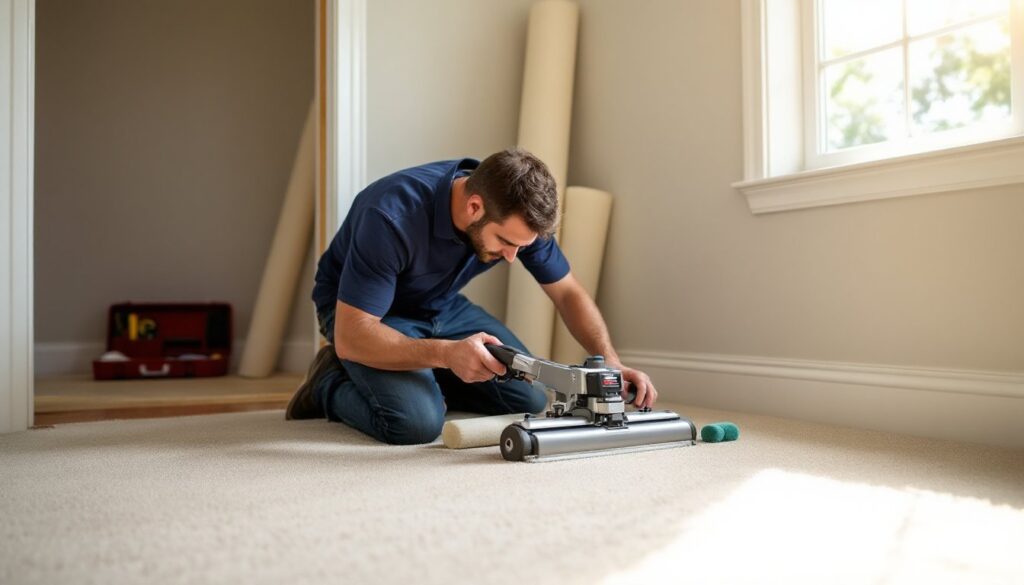
Tools required for a DIY install include a carpet knife (or utility knife with fresh blades), knee kicker, power stretcher, seam roller, stair tool, and a tack strip cutter. Buying these outright costs $200 to $600: renting a power stretcher and knee kicker runs $40 to $80 per day. Most big-box stores offer rental packages.
Skill level matters. Cutting carpet to fit irregular walls, seaming two pieces invisibly, and stretching it tight without wrinkles takes practice. A poorly stretched carpet will ripple within months. Stairs are especially tricky, one miscalculation wastes material and creates a safety hazard.
Time investment is real. A 12×15 room might take a pro three hours but a first-timer a full day, especially with furniture moving and cleanup. Stairs can double that.
Savings breakdown: If material costs $3 per square foot and pro installation adds $2 per square foot, a 200-square-foot room costs $1,000 installed. DIY drops that to $600 (material + padding + rentals). For multi-room projects, the labor savings multiply.
When to hire a pro:
- Complex layouts with lots of seams, angled walls, or built-ins
- Stairs, pros have jigs and techniques that prevent costly mistakes
- Subfloor issues, water damage, uneven concrete, or structural concerns require expertise
- Warranty protection, some carpet manufacturers void warranties if installation isn’t done by a certified installer
- Time constraints, pros finish in hours, not weekends
When DIY makes sense:
- Simple, square rooms with minimal transitions
- Low-traffic areas like spare bedrooms where minor imperfections won’t show
- Budget is tight and the homeowner has basic tool skills
- Learning opportunity, tackling a small closet first builds confidence for larger projects
For homeowners weighing options, resources like ImproveNet offer project calculators and contractor comparisons to clarify the cost-benefit tradeoff.
Bottom line: DIY carpet installation can save money, but mistakes cost more than hiring a pro upfront. First-timers should start small, rent quality tools, and watch multiple installation videos before cutting into expensive material.