
Tired of looking at those outdated kitchen cabinets but dreading the price tag of a full replacement? Cabinet refacing offers a middle ground, a way to transform your kitchen’s look without the expense and disruption of gutting everything. In 2026, kitchen cabinet refacing costs continue to attract homeowners seeking a budget-friendly update. But what does refacing actually run, and where does your money go? This guide breaks down current pricing, compares refacing to other options like refinishing and replacement, and shows how to maximize value whether you hire pros or tackle parts yourself.
Table of Contents
ToggleKey Takeaways
- Kitchen cabinet refacing costs between $4,200 and $10,200 nationally in 2026, with pricing driven by materials (laminate, wood, or rigid thermofoil) and your kitchen’s linear footage.
- Cabinet refacing replaces only doors, drawer fronts, and veneer while keeping existing frames, making it 40–60% cheaper than full replacement and faster to install at just two to four days.
- Material choice significantly impacts your budget: laminate runs $150–$300 per linear foot, wood veneer ranges $250–$450, and rigid thermofoil sits in the middle at $200–$400 per linear foot.
- DIY cabinet refacing can cut costs by 50% or more but requires patience, proper tools, and careful measuring—hiring professionals guarantees speed, experience, and warranty protection.
- Get at least three itemized quotes from contractors and book during off-season (late fall/winter) to secure better rates and avoid overpaying for kitchen cabinet refacing costs.
What Is Kitchen Cabinet Refacing and How Does It Work?
Cabinet refacing means keeping your existing cabinet boxes (the structural frames) while replacing just the visible parts: doors, drawer fronts, and the thin veneer covering the box exteriors. Hardware gets swapped too, hinges, handles, pulls. Think of it as giving cabinets a new skin without rebuilding the skeleton.
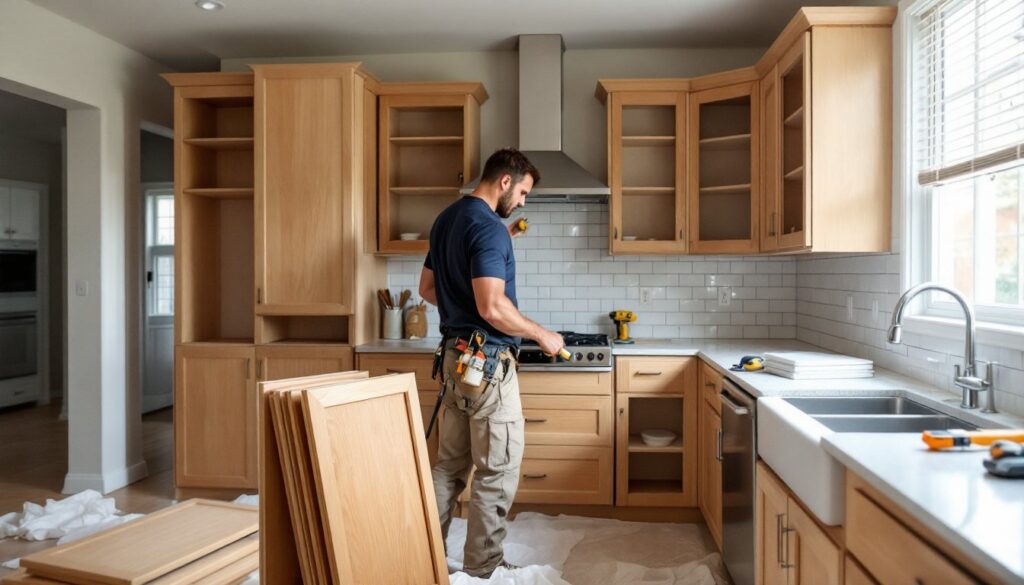
The process starts with removing old doors and drawer fronts. Next, a thin veneer (usually wood, laminate, or rigid thermofoil, or RTF) gets applied to the exposed cabinet frames, covering the old finish. New doors and drawer fronts, color and style-matched to the veneer, get installed along with fresh hardware. The whole job typically takes two to four days for an average kitchen, depending on size and complexity.
Refacing works best when cabinet boxes are structurally sound but cosmetically dated. If hinges are loose, boxes are sagging, or you need a different layout, refacing won’t fix those issues. It’s a cosmetic upgrade, not a structural overhaul. But for kitchens where the bones are good and you just hate the look, it delivers dramatic results at a fraction of replacement cost.
Average Cost of Cabinet Refacing: National Breakdown
In 2026, the national average for professional cabinet refacing sits around $7,200 to $7,500 for a typical 10×12-foot kitchen with 20 linear feet of cabinetry. Most homeowners spend between $4,200 and $10,200, though high-end materials or complex layouts can push totals higher.
Contractors typically charge $200 to $500 per linear foot of cabinet face, depending on materials and labor rates in your area. A small galley kitchen (10 linear feet) might run $2,000 to $5,000, while a large L-shaped or U-shaped kitchen (30+ linear feet) can hit $12,000 or more.
Material choice drives much of the variation. Laminate veneers and doors run cheapest, $150 to $300 per linear foot installed. Wood veneers (oak, maple, cherry) cost $250 to $450 per linear foot. Rigid thermofoil (RTF) doors resist moisture and sit in the middle, around $200 to $400 per linear foot. Custom hardwoods or exotic veneers can exceed $500 per linear foot.
Labor accounts for roughly 40–50% of the total. In high-cost metro areas (New York, San Francisco, Seattle), expect the upper end of pricing. Smaller markets and rural areas trend lower. Get at least three quotes to gauge local rates, prices fluctuate with demand and contractor availability.
What Factors Impact Cabinet Refacing Costs?
Several variables shift the final bill beyond simple linear footage.
Kitchen size and layout matter most. More cabinets mean more doors, more veneer, more labor. Kitchens with lots of corners, odd angles, or built-in features (lazy Susans, pull-outs) add complexity and time.
Condition of existing boxes affects prep. If frames need minor repairs, tightening hinges, shimming doors, patching holes, labor ticks up. Major damage might mean boxes can’t support new veneer, pushing you toward replacement instead.
Hardware upgrades can be modest or extravagant. Basic pulls and hinges add $2 to $5 per cabinet door. Soft-close hinges, designer pulls, or integrated LED lighting can double hardware costs.
Add-ons like crown molding, under-cabinet lighting, or new toe kicks increase the scope. Crown molding alone can add $500 to $1,500 depending on material and linear footage.
Material Choices and Pricing
Laminate remains the budget king. It’s durable, easy to clean, and available in dozens of colors and faux-wood finishes. It won’t fool anyone looking closely, but it holds up well to daily use. Expect $150 to $300 per linear foot installed.
Wood veneer offers authentic grain and the option to stain or paint. Oak, maple, and birch are common and affordable: cherry, walnut, and exotic species cost more. Real wood can be sanded and refinished down the road, adding longevity. Figure $250 to $450 per linear foot.
Rigid thermofoil (RTF) is a vinyl layer heat-bonded to MDF. It resists moisture better than wood, making it smart near sinks and dishwashers. It comes in smooth or textured finishes but can peel if exposed to high heat (like next to a poorly vented stove). Cost runs $200 to $400 per linear foot.
Solid hardwood doors (no veneer, just solid slabs or frame-and-panel construction) offer the highest quality and longevity but push costs to $400 to $600+ per linear foot. Reserve these for kitchens where you plan to stay long-term.
Cabinet Refacing vs. Replacement: Which Saves You More?
Cabinet refacing costs significantly less than full replacement, usually 40–60% less. A complete cabinet replacement in 2026 runs $8,000 to $25,000+ for the same kitchen, depending on materials (stock vs. semi-custom vs. custom) and installation complexity.
Replacement makes sense if you need a new layout, additional storage, or cabinets are structurally failing. It’s the only way to move walls, add islands, or reconfigure work triangles. But it’s also messier, slower (one to three weeks), and often requires plumbing or electrical adjustments.
Refacing shines when boxes are solid and layout works. You save money, time, and avoid the disruption of a full demo. But you’re stuck with the existing footprint and internal configuration.
Cabinet refinishing (stripping, sanding, and repainting or restaining existing doors and boxes) costs even less, typically $1,500 to $4,000 for a full kitchen. Kitchen cabinet refinishing cost depends on the number of doors, condition of the finish, and whether you hire pros or DIY. Refinishing keeps the same doors and hardware, so it won’t change style, just color or sheen. It’s the budget option if you like your door style but hate the color.
Compare kitchen cabinets refacing costs to refinishing: refacing delivers a style change (new doors, new look), while refinishing delivers a color change (same doors, new finish). Refacing costs more but offers a bigger visual update. Replacement costs the most but allows a complete redesign.
DIY Cabinet Refacing: Can You Cut Costs by Doing It Yourself?
Doing it yourself can slash costs by 50% or more, but it’s not a weekend project. DIY cabinet refacing suits patient, detail-oriented homeowners comfortable with measuring, cutting, and applying adhesives.
You’ll need to source materials: peel-and-stick veneer or contact paper for box faces (easier than traditional veneer), new doors (buy semi-custom or stock from big-box stores or online suppliers), and hardware. Budget $1,000 to $3,000 in materials for an average kitchen, depending on door style and veneer quality.
Tools required include a tape measure, utility knife or veneer trimmer, straightedge, J-roller (for pressing veneer), drill, and screwdriver. A heat gun helps smooth bubbles in peel-and-stick veneer.
The trickiest part? Applying veneer without bubbles, wrinkles, or misalignment. Practice on a hidden section first. Doors must match existing box dimensions, measure twice, order once. Mismatched doors are expensive mistakes.
Pros bring speed, experience, and warranty. A professional cabinet refacing service finishes in days what might take a DIYer weeks. They also handle tricky cuts around hinges, corner cabinets, and built-ins. If you value time or worry about results, hire out. If you’re handy and have patience, DIY saves serious money.
One hybrid approach: DIY the veneer application and buy pre-made doors, but hire a pro to install doors and hardware. This splits the labor and keeps the job manageable.
How to Get the Best Deal on Cabinet Refacing
Start by getting at least three quotes from licensed, insured contractors. Ask for itemized estimates showing material, labor, and add-on costs separately. This lets you compare apples-to-apples and spot padding.
Timing matters. Contractors often offer discounts in late fall or winter when demand slows. Book during off-peak months for better rates and faster scheduling.
Material swaps save money without sacrificing much. Swap exotic hardwood veneer for maple or oak. Choose standard door styles (shaker, flat-panel) over custom profiles. Skip soft-close hinges if you’re on a tight budget, they’re nice but not essential.
Reuse hardware if it’s in good shape. A coat of spray paint can refresh old pulls and knobs for a few bucks instead of $5+ each for new ones.
Check for rebates or financing. Some contractors partner with material suppliers or banks offering zero-interest financing for 6–12 months. Home improvement stores occasionally run promotions on cabinet refacing services or materials.
Don’t confuse cost with value. The cheapest quote isn’t always the best deal if materials are low-grade or the contractor lacks references. Read reviews on platforms like Angi or ImproveNet to vet contractors before signing.
Finally, ask about warranties. Reputable contractors warranty labor for at least one year and pass through manufacturer warranties on doors and veneer. If something peels or a door warps, you want coverage.
How much to refinish kitchen cabinets versus reface them? Refinishing runs $1,500 to $4,000 and keeps existing doors. Refacing runs $4,200 to $10,200+ and replaces doors and veneer. The cost to reface kitchen cabinets delivers a bigger visual transformation, but refinishing works if you love your current style and just want a fresh color. Weigh kitchen cabinets refacing costs against your goals and budget to pick the right path.