
Switching to a tankless water heater can slash your energy bills and free up valuable floor space, but what’s it actually going to cost? In 2026, homeowners are paying anywhere from $1,200 to $5,500+ for a complete installation, depending on fuel type, unit capacity, and how much of the existing plumbing needs to be reworked. That’s a wide range, and the devil’s in the details. Whether you’re replacing an aging tank model or installing your first on-demand system, understanding the cost breakdown upfront helps you budget accurately and avoid sticker shock when the invoice arrives. This guide walks through real-world pricing, hidden expenses, and where you can, and can’t, cut corners.
Table of Contents
ToggleKey Takeaways
- Tankless water heater installation cost ranges from $1,200 to $5,500+, with most homeowners paying $2,600 to $4,500 for a complete professional setup including labor and materials.
- Electric units are the most budget-friendly at $1,200–$3,000 installed, while gas models cost $2,500–$5,500 due to venting and potential gas line upgrades ($500–$2,000 extra).
- Hidden expenses like electrical panel upgrades ($800–$2,500), venting materials ($300–$800), water softeners ($400–$1,200), and annual maintenance ($150–$250) can significantly increase your total investment.
- Hire licensed professionals for all gas installations and electrical panel work to ensure safety, code compliance, and avoid voiding insurance; DIY is only suitable for simple electric point-of-use swaps.
- Shopping for at least three written quotes, timing installation in spring or fall, and leveraging federal tax credits (up to $600) and utility rebates can save $400–$800 on your project.
Average Cost to Install a Tankless Water Heater
Most homeowners spend $2,600 to $4,500 for a professionally installed tankless water heater, including the unit and labor. That figure covers mid-range equipment, standard gas or electric hookups, and a straightforward swap in an existing utility space. On the low end, a basic electric model in an apartment or condo can run as little as $1,200, while a whole-house gas unit with extensive venting upgrades or electrical panel work can push past $5,500.
Labor typically accounts for $600 to $1,800 of the total, depending on your region and the complexity of the job. If you’re in a high-cost metro area or need to run new gas lines, expect to land at the upper end of that range. Materials, piping, fittings, venting components, and mounting hardware, add another $100 to $400.
Cost Breakdown by Unit Type
Electric tankless water heaters are the most budget-friendly upfront, with units priced between $500 and $1,500. Installation is simpler because there’s no venting required, but you may need a 240V dedicated circuit and an electrical panel upgrade if your home’s capacity is already maxed out. Total installed cost: $1,200 to $3,000.
Gas tankless models (natural gas or propane) range from $800 to $2,500 for the unit alone. They deliver higher flow rates for whole-house demand but require proper venting, either through an existing chimney or a new category III stainless-steel vent run. Installation with venting work typically lands between $2,500 and $5,500. If your home doesn’t have a gas line nearby, budget an extra $500 to $2,000 to run one.
Condensing vs. non-condensing models also affect price. Condensing units capture more heat from exhaust gases, boosting efficiency to 95%+, but cost $300 to $600 more than non-condensing versions. They use PVC venting, which is cheaper and easier to install than the stainless-steel flue required for non-condensing units, a trade-off that can actually save money on labor.
Factors That Impact Your Installation Cost
Fuel type is the biggest driver. Electric tankless water heater installation cost is lower because you’re not dealing with combustion venting or gas line work. Gas units cost more to install but often deliver better performance for larger households.
Unit capacity matters, too. Flow rate is measured in gallons per minute (GPM), and you’ll need enough to cover simultaneous demand, say, a shower running at 2.5 GPM while the dishwasher pulls another 1.5 GPM. Whole-house units rated at 8–10 GPM cost significantly more than point-of-use models rated at 2–3 GPM.
Existing infrastructure can make or break your budget. If you’re swapping a tank water heater for a tankless, you may need to:
- Upgrade your gas line from ½-inch to ¾-inch or larger to supply the higher BTU demand (gas units pull 150,000–200,000 BTU/hr vs. 30,000–40,000 BTU/hr for tanks).
- Install a new venting system if your existing chimney isn’t compatible.
- Add a dedicated electrical circuit or upgrade your service panel to handle the amperage.
- Relocate the unit if your current tank sits in a tight closet without clearance for venting or access.
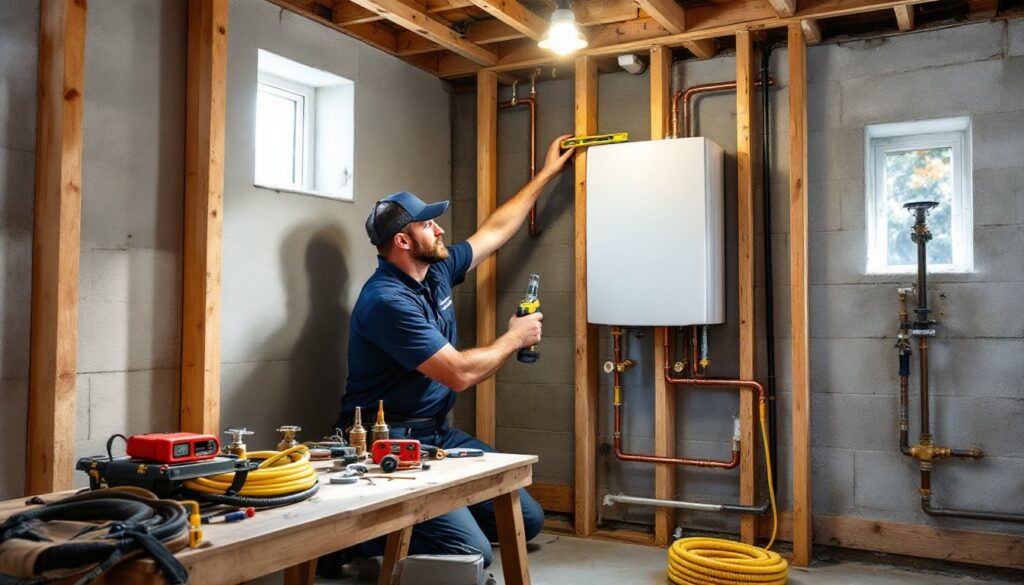
Location and labor rates vary widely. A straightforward swap in a basement utility room with nearby gas and electrical access is cheaper than mounting a unit on an exterior wall with new conduit andvent penetrations. Markets with higher costs of tankless water heater installation, think coastal metro areas or regions with strict permitting, add 15–30% to the invoice.
Permits and inspections are required in most jurisdictions for gas and electrical work. Budget $50 to $200 for permit fees, and factor in the time for inspections, which can delay completion by a few days.
DIY vs. Professional Installation: What You Need to Know
Installing a tankless water heater yourself can save $600 to $1,800 in labor, but it’s not a beginner-level project. You’re dealing with natural gas or propane, high-voltage electrical, and pressure plumbing, any of which can turn dangerous if done wrong.
When DIY makes sense: If you’re a confident DIYer with plumbing and electrical experience, you can handle a direct swap of an electric point-of-use unit in a space with existing 240V wiring and accessible water lines. You’ll need basic tools: pipe wrench, tubing cutter, Teflon tape, wire strippers, and a multimeter. Follow the manufacturer’s manual to the letter, especially on clearances and mounting specs.
When to call a pro: Gas installations almost always require a licensed plumber or HVAC tech. Running new gas lines, sizing supply piping, pressure-testing joints, and configuring venting are all governed by the International Fuel Gas Code (IFGC) and local amendments. Mess up the venting, and you risk carbon monoxide buildup, not a mistake you want to make. Electrical panel upgrades also require a licensed electrician in most areas.
Permits complicate DIY. Even if you’re capable, many jurisdictions won’t issue permits to homeowners for gas or electrical work. No permit means no inspection, and no inspection can void your homeowner’s insurance if something goes wrong.
Bottom line: for water heating efficiency and peace of mind, hire a pro for gas units and anything involving panel work. Save DIY for simple electric point-of-use swaps where you’re confident in your skills and the code allows it.
Hidden Costs and Additional Expenses to Budget For
The sticker price rarely tells the whole story. Here’s what can sneak up on you:
Gas line upgrades: If your existing line is undersized, running a new ¾-inch or 1-inch black iron pipe from the meter adds $500 to $1,500, depending on distance and wall penetrations.
Electrical panel upgrades: Adding a 40–60 amp breaker for an electric unit might require a panel upgrade if you’re out of slots or capacity. That’s $800 to $2,500 for a new 200-amp service panel and associated labor.
Venting materials and labor: Non-condensing gas units need category III stainless-steel venting, which runs $10–$15 per linear foot plus elbows, termination caps, and flashing. A typical installation uses 15–25 feet, adding $300 to $800 in materials and another $400 to $1,000 in labor if you’re cutting through an exterior wall or roof.
Water softener or filtration: Hard water clogs tankless heat exchangers. If your water hardness exceeds 7 grains per gallon, budget $400 to $1,200 for a water softener or plan on annual descaling maintenance ($150–$250 per service call).
Removal and disposal: Hauling out the old tank water heater costs $50 to $150 unless your installer includes it in the quote. Some municipalities charge disposal fees for tanks over 40 gallons.
Structural modifications: Mounting a tankless unit on an exterior wall may require blocking between studs for secure anchoring, especially for heavy gas models. If you’re relocating the unit, patching drywall, repainting, or rerouting plumbing adds time and materials.
Annual maintenance: Tankless units need periodic flushing to remove mineral buildup. DIY descaling kits cost $20–$40, or hire a pro for $150–$250 annually. Skip it, and you’ll void your warranty and shorten the unit’s lifespan.
How to Save Money on Your Tankless Water Heater Installation
Get multiple quotes. Prices vary wildly by contractor, even in the same zip code. Aim for at least three written estimates that break out equipment, labor, and materials. Watch for low-ball bids that skip permit fees or venting upgrades, they’ll hit you with change orders later.
Time it right. Plumbers and HVAC techs are busiest in winter (furnace season) and summer (AC installs). Schedule your install in spring or fall for better availability and potentially lower rates.
Choose the right size unit. Oversizing wastes money upfront and reduces efficiency. Calculate your peak demand: 1.5 GPM per shower, 1.0 GPM per faucet, 1.5 GPM per dishwasher. A family of four with two bathrooms rarely needs more than 6–8 GPM in moderate climates. In cold regions where groundwater enters at 40°F, you’ll need a higher GPM to achieve the same temperature rise.
Leverage rebates and tax credits. The Inflation Reduction Act offers federal tax credits up to $600 for high-efficiency water heaters (Energy Star certified, efficiency factor ≥ 0.82). Many utilities also provide rebates of $100–$500 for qualifying units. Check the Database of State Incentives for Renewables & Efficiency (DSIRE) and your utility’s website before you buy.
Consider a hybrid approach. If you only need instant hot water at one sink or shower, a point-of-use electric unit ($200–$500 installed) can supplement your existing tank and delay a full replacement. It’s not a permanent solution, but it buys you time to save for a whole-house upgrade.
Bundle the work. If you’re already upgrading your electrical panel for a kitchen remodel or adding a gas line for a range, coordinate the tankless install to share permit fees and minimize service calls.
Ask about used or refurbished units. Some contractors offer factory-refurbished models at 20–30% off retail. Make sure they come with a warranty and are installed by a licensed pro, this isn’t the place to cut corners on quality.
According to recent industry data, homeowners who shop around and time their projects strategically save an average of $400–$800 compared to those who hire the first contractor they call. That’s real money you can put toward the water softener or annual maintenance down the road. For more cost-saving strategies on home systems, resources like ImproveNet offer detailed project planning tools and regional pricing guides.
Conclusion
A tankless water heater is a solid investment for the right home, lower operating costs, endless hot water, and a 20-year lifespan make the upfront expense easier to swallow. Budget realistically, account for the hidden costs, and don’t skimp on professional help for gas or electrical work. Done right, you’ll enjoy decades of efficient, on-demand hot water and a system that pays for itself in energy savings.