
Swapping out that old tub for a sleek shower can open up your bathroom, make it more accessible, and modernize the space, but it’s not a cheap weekend project. A tub to shower conversion typically runs anywhere from $1,800 to $10,000+, depending on how fancy you want to get and whether you’re doing any of the work yourself. The price swing comes down to materials, labor, plumbing adjustments, and whether you’re installing a basic fiberglass kit or a custom-tiled enclosure with rain showerheads and body jets. If you’re planning this conversion, you’ll want a clear picture of what drives those costs so you can budget smart and avoid surprises halfway through demolition.
Table of Contents
ToggleKey Takeaways
- Tub to shower conversion costs typically range from $1,800 to $10,000+, with most homeowners spending $3,000 to $7,500 for a straightforward replacement in 2026.
- Prefabricated shower kits offer the most budget-friendly option at $1,200 to $3,500 all-in, while custom tile showers can reach $4,500 to $10,000+ for premium designs and finishes.
- Plumbing relocations, wall repairs, and accessibility features are major cost drivers that can add $500 to $2,000 each to your total project expense.
- DIY conversions can save 40–60% on labor costs, but mistakes in waterproofing, plumbing, or tile work can result in costly repairs exceeding $2,500.
- Smart cost-saving strategies include sticking with your existing footprint, choosing mid-grade materials like porcelain tile, doing your own demolition, and getting multiple contractor quotes before committing.
- Booking your conversion project in late fall or winter can net 10–20% lower contractor rates compared to peak spring and summer seasons.
Average Cost of Converting a Tub to a Shower
For 2026, the average cost of tub to shower conversion sits around $3,000 to $7,500 for most homeowners. That’s for a straightforward replacement, ripping out the tub, prepping the walls and floor, installing a new shower base and surround, and getting the plumbing dialed in. If you’re hiring a pro for the whole job, labor alone can account for $1,000 to $3,000 of that total.
Nationwide data from industry cost guides shows the low end starts around $1,800 for a DIY-friendly prefab kit with minimal plumbing tweaks, while high-end custom tile showers with frameless glass doors and upgraded fixtures can push past $10,000. Geographic location matters, too, contractors in metro areas or coastal cities typically charge 20–40% more than those in the Midwest or rural regions.
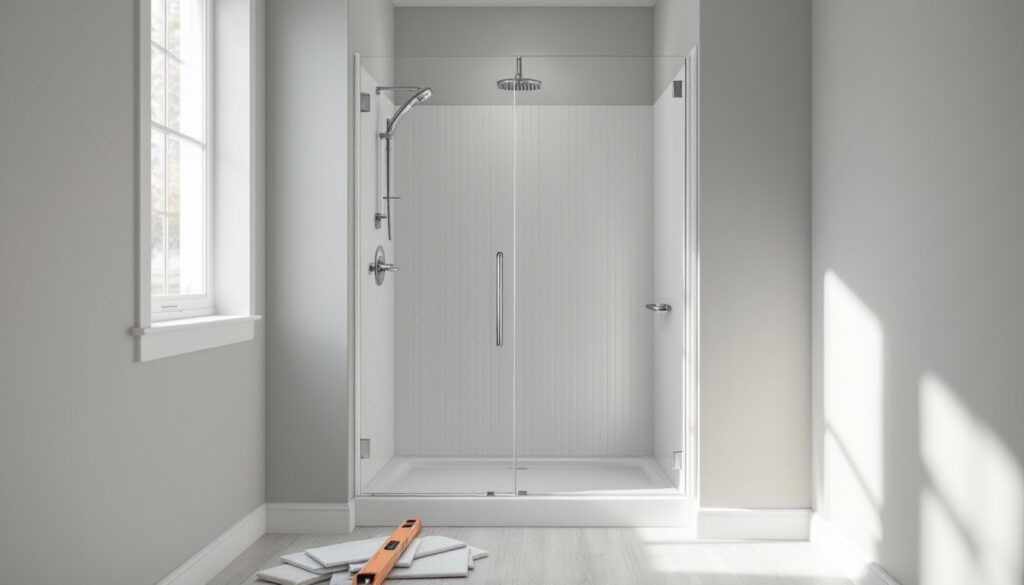
The convert tub to walk-in shower cost often lands on the higher side of that range because walk-in designs usually involve low-threshold or zero-entry pans, which may require floor modifications, additional waterproofing, and ADA-compliant grab bars. Expect to add $500 to $1,500 for accessibility features if you’re building a barrier-free shower.
Keep in mind that these are ballpark figures. Your final bill depends on material choices, existing plumbing condition, and whether you need permits, most jurisdictions require one for any work that touches drainage or structural framing.
Cost Breakdown by Conversion Type
Not all shower conversions are created equal. Here’s how pricing breaks down by the two most common routes.
Prefabricated Shower Kits
Prefab kits are the budget-friendly, speed-oriented option. You get a molded shower pan (the base), matching wall panels (usually fiberglass, acrylic, or composite), and sometimes a door, all designed to fit standard tub alcoves (60″ × 32″ is the most common footprint).
Typical cost range: $400 to $1,500 for the kit itself, plus $800 to $2,000 for professional installation. All-in, you’re looking at $1,200 to $3,500.
Pros:
• Fast install, often wrapped in one to two days
• Fewer seams mean less risk of leaks
• No grout maintenance
• DIY-friendly if you’re comfortable with basic plumbing and carpentry
Cons:
• Limited design options, you’re stuck with stock colors and layouts
• Lower-end kits can feel flimsy and may crack over time
• Hard to match unique alcove dimensions without custom trimming
Best for: Rental properties, quick flips, or homeowners on a tight timeline and budget.
Custom Tile Showers
Custom tile gives you total design control, choose your tile size, pattern, grout color, niche placement, and fixtures. You’ll need a mortar bed or pre-sloped foam pan, cement backer board, a waterproof membrane (like Schluter or RedGard), tile, grout, and sealant.
Typical cost range: $2,000 to $5,000 for materials and $2,500 to $5,000+ for skilled tile labor. Total: $4,500 to $10,000+.
Pros:
• Full customization, size, layout, finishes
• High-end look that boosts resale value
• Repairable, damaged tiles can be swapped out individually
Cons:
• Longer install time (3–7 days)
• Grout requires regular sealing to prevent mold and staining
• Higher upfront cost
• Mistakes in waterproofing can lead to expensive water damage
Best for: Forever homes, luxury remodels, or anyone who wants a one-of-a-kind shower that fits odd dimensions.
Factors That Affect Your Conversion Cost
Every bathroom is different, and a handful of variables can nudge your project into budget territory, or blow it wide open.
Plumbing relocations: If your new showerhead, valve, or drain don’t line up with the old tub’s plumbing, you’ll need to reroute pipes. Moving a drain more than a few inches often means cutting into the floor or ceiling below, adding $500 to $2,000 in plumber fees. Valve and supply line moves are cheaper but still run $200 to $600.
Wall and floor prep: Pulling out a tub often reveals water damage, mold, or outdated framing. Rotted studs, subfloor repairs, or mold remediation can tack on $300 to $1,500. If your walls aren’t plumb or square, expect extra labor to shim and level.
Door and enclosure choice: A basic shower curtain costs almost nothing. A mid-grade framed glass door runs $200 to $500, while a frameless tempered-glass enclosure starts around $800 and can hit $2,000+ for custom sizing.
Fixture upgrades: Swapping a builder-grade chrome valve for a thermostatic mixer with volume controls adds $150 to $400. Rain heads, handheld wands, and body sprays each add $75 to $300 per fixture, plus installation.
Accessibility features: Grab bars, fold-down seats, and low-threshold pans are common walk-in shower upgrades that range from $100 to $800 depending on materials and mounting requirements. If you’re aiming for ADA compliance, budget for reinforced blocking behind walls during framing.
Permits and inspections: Most cities require a plumbing permit (typically $50 to $200) for tub-to-shower conversions. Skipping it can cause headaches down the road, failed inspections, insurance snags, or resale issues.
DIY vs. Professional Installation: Which Saves More?
Going DIY can cut your costs by 40–60%, but only if you’ve got the skills and tools to pull it off without callback-worthy mistakes.
DIY savings potential:
If you handle demo, pan install, wall surround, and fixture hookup yourself, you’re mainly paying for materials, figure $800 to $2,500 for a prefab kit or $1,500 to $4,000 for a tile job. You’ll need a reciprocating saw, level, drill, PVC cutter, possibly a tile saw, and a mixing drill for thinset. Factor in $100 to $300 for tool rentals if you don’t own them.
Where DIY makes sense:
• Installing a prefab kit in a standard alcove with no plumbing moves
• Surface-level cosmetic work (replacing a valve trim, upgrading a showerhead)
• You have prior plumbing or tile experience
When to call a pro:
• Any drain relocation or supply line rerouting, plumbing codes are strict, and a bad solder joint or improper slope can cause slow drains or leaks behind walls
• Custom tile work, proper slope, waterproofing membrane application, and grout technique take practice: one missed step and you’re dealing with a leak a year later
• Load-bearing wall modifications or framing changes
• If your local code requires licensed plumbers for permit sign-off
Cost of mistakes: A botched shower pan install can lead to subfloor rot costing $1,000 to $3,000 to fix. Improper waterproofing behind tile can mean tearing it all out and starting over, $2,500 to $5,000. That wipes out any DIY savings in a hurry.
Hybrid approach: Many homeowners tackle demo and prep themselves, then hire a plumber for rough-in and a tile setter for the finish work. That can shave $500 to $1,200 off labor while keeping quality high.
Ways to Reduce Your Tub to Shower Conversion Costs
You don’t have to settle for builder-grade basics, but a few smart moves can keep your budget in check without sacrificing quality.
Stick with the existing footprint: Don’t move walls, drains, or supply lines if you can help it. Using the same alcove dimensions and plumbing locations is the single biggest cost saver.
Choose mid-grade materials: You don’t need Carrara marble to get a clean look. Porcelain tile (12″ × 24″) offers durability and style at $3 to $8 per square foot, compared to natural stone at $10 to $25+. Acrylic shower bases hold up well and cost half what solid-surface pans do.
Reuse fixtures when possible: If your existing valve body is in good shape and meets code, just replace the trim kit and showerhead. A new trim plate and handle runs $40 to $150, versus $300 to $600 for a full valve replacement.
Do your own demo: Ripping out the old tub, tile, and backer board is labor-intensive but not technically complex. You’ll save $300 to $800 in contractor time. Just wear safety goggles, gloves, and a dust mask, old tile and plaster create nasty dust. Dispose of debris responsibly: many home improvement resources offer guidance on proper disposal and recycling.
Shop sales and surplus: Big-box stores mark down discontinued tile, fixtures, and enclosures by 30–50%. Habitat for Humanity ReStores and salvage yards sometimes have like-new shower doors and hardware.
Get multiple quotes: Prices for the same job can vary by $1,000 or more between contractors. Aim for at least three written estimates, and don’t automatically pick the cheapest, check references and verify licensing.
Bundle with other bathroom work: If you’re already redoing the vanity or floor, adding the shower conversion in the same project can reduce mobilization fees and per-day labor rates.
Time it right: Contractors are busier (and pricier) in spring and summer. Booking in late fall or winter can net you 10–20% lower rates in some markets.